Showing posts with label Biodiversity - Chapter 3. Show all posts

Friday, June 2, 2017

What Can You Do To Conserve Genetic Diversity?

Source: Food and Agriculture Organization of the United Nations, 2013, Cary Fowler, Charlotte Lusty and Maria Vinje Dodson, and Global Crop Diversity Trust, "The Youth Guide to Biodiversity" 1st Edition (Chapter 3) Youth and United Nations Global Alliance. Reproduced with permission.

Chapter 3. Verbatim.


Visit a local Farmers’ Market. The farmers usually grow and sell local varieties of fruits and vegetables that you won’t find in the supermarket. By buying their products you are encouraging the farmers to continue growing genetically distinct varieties.

Biodiversity International

Source: Food and Agriculture Organization of the United Nations, 2013, Cary Fowler, Charlotte Lusty and Maria Vinje Dodson, and Global Crop Diversity Trust, "The Youth Guide to Biodiversity" 1st Edition (Chapter 3) Youth and United Nations Global Alliance. Reproduced with permission.

Chapter 3. Verbatim.

Bioversity International uses agricultural biodiversity to improve people’s lives by researching solutions for three key challenges: sustainable agriculture, nutrition and conservation. Bioversity maintains the international Germplasm Collection of both improved varieties and wild species of bananas.

The World's Largest Ex Situ Collections

Source: Food and Agriculture Organization of the United Nations, 2013, Cary Fowler, Charlotte Lusty and Maria Vinje Dodson, and Global Crop Diversity Trust, "The Youth Guide to Biodiversity" 1st Edition (Chapter 3) Youth and United Nations Global Alliance. Reproduced with permission.

Chapter 3. Verbatim.

The International Maize and Wheat Improvement Center (CIMMYT) is a research and training center with the objective to sustainably increase the productivity of maize and wheat systems to ensure global food security and reduce poverty. 

Genetic Diversity Forever

Source: Food and Agriculture Organization of the United Nations, 2013, Cary Fowler, Charlotte Lusty and Maria Vinje Dodson, and Global Crop Diversity Trust, "The Youth Guide to Biodiversity" 1st Edition (Chapter 3) Youth and United Nations Global Alliance. Reproduced with permission.

Chapter 3.Verbatim
The Svalbard seed vault cut within the mountain in Norway.
© Global Crop Diversity Trust
Entrance to the Svalbard seed vault in Norway.
© Svalbard Global Seed Vault/Mari Tefre
Communities or individual farmers have been safeguarding their seeds and animal breeds since organised agriculture began. With a better knowledge of genetics and evolution, scientists began to recognise the significance of diversity and collect rare breeds and crop varieties. Today there is a worldwide network of institutes that conserves the seeds, roots and tubers of crops in genebanks.

Genetic Diversity Under Threat

Source: Food and Agriculture Organization of the United Nations, 2013, Cary Fowler, Charlotte Lusty and Maria Vinje Dodson, and Global Crop Diversity Trust, "The Youth Guide to Biodiversity" 1st Edition (Chapter 3) Youth and United Nations Global Alliance. Reproduced with permission.

Chapter 3. Verbatim.

A place without genetic diversity is chronically fragile and poised for disaster. In 1845, a deadly disease destroyed the potato crop, the main crop of the rural poor in Ireland, leading to the starvation or migration of two million people. There have been many events like this in human history.

The Making of Our Daily Bread

Source: Food and Agriculture Organization of the United Nations, 2013, Cary Fowler, Charlotte Lusty and Maria Vinje Dodson, and Global Crop Diversity Trust, "The Youth Guide to Biodiversity" 1st Edition (Chapter 3) Youth and United Nations Global Alliance. Reproduced with permission.


Chapter 3. Verbatim.


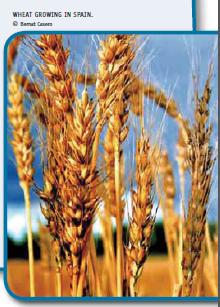
In the 1940s, farmers were losing much of their wheat crop to a fungus known as stem rust. The fungal spores are carried by the wind from field to field. The spores can land on any part of the wheat plant and infect it, forming pustules on the stem and leaves, and causing the plant to produce much less seed, if not to die altogether.

Genetic Diversity in Use

Source: Food and Agriculture Organization of the United Nations, 2013, Cary Fowler, Charlotte Lusty and Maria Vinje Dodson, and Global Crop Diversity Trust, "The Youth Guide to Biodiversity" 1st Edition (Chapter 3) Youth and United Nations Global Alliance. Reproduced with permission.

Chapter 3. Verbatim.


Diversity plays a key role in evolution and the survival of species. There are endless examples, from the dinosaur to the dodo, where a species lacked variation or the ability to adapt to pressures in its environment and became extinct. In the case of humans, we have so successfully adapted to our environment that we are now one of the major factors shaping and changing the planet. Despite this fact, we are still highly dependent on diversity at all levels.

Who’s More Diverse, Humans or Maize?

Source: Food and Agriculture Organization of the United Nations, 2013, Cary Fowler, Charlotte Lusty and Maria Vinje Dodson, and Global Crop Diversity Trust, "The Youth Guide to Biodiversity" 1st Edition (Chapter 3) Youth and United Nations Global Alliance. Reproduced with permission


Chapter 3. Verbatim.


Although humans may look diverse they are actually genetically very similar. In fact there is more diversity in a single field of maize than there is in the entire human population! Can you imagine the potential for maize to develop into many different types of crops?

Forces of Evolution

Source: Food and Agriculture Organization of the United Nations, 2013, Cary Fowler, Charlotte Lusty and Maria Vinje Dodson, and Global Crop Diversity Trust, "The Youth Guide to Biodiversity" 1st Edition (Chapter 3) Youth and United Nations Global Alliance. Reproduced with permission.


Chapter 3. Verbatim.


Let’s go back to eye colour, only let’s imagine there is a forest that is home to a population of pigeons with different eye colours – let’s say some have green eyes and others grey-eyes. By chance, the green-eyed pigeons are particularly good at seeing in the dark. In this imaginary forest, the pigeons feed all day on delicious figs only available on a small number of fig trees. During the night, the birds rest. But a change in the climate drives a new species of pigeon-hunting eagle into the area. The eagle’s talent for diving from a great height onto pigeons feeding inthe fruit trees depends on good daytime visibility. 

Genetic Diversity

Source: Food and Agriculture Organization of the United Nations, 2013, Cary Fowler, Charlotte Lusty and Maria Vinje Dodson, and Global Crop Diversity Trust, "The Youth Guide to Biodiversity" 1st Edition (Chapter 3) Youth and United Nations Global Alliance. Reproduced with permission.


Chapter 3. Verbatim.
Putting it simply, genes produce traits. A trait is a characteristic such as curly hair, freckles or blood type. Genes act singularly or in combination to produce traits, many of which are very obvious. Human eye colour, for instance, is determined by a combination of genes, giving colours of blue, green, brown, hazel, grey, chestnut and variations in between. This is genetic diversity.
When you look at the eyes of the population of a town or country in Europe or North America, there may be great variation in eye colour. Elsewhere, for instance in parts of Africa and Asia, eye colour may not vary much at all.


The eye colour example shows diversity within a single species – the human species. But there’s also genetic diversity within a group of species – pigeons, for instance! If you travel to an island or a forest in the tropics, you will almost certainly find pigeons. You will recognise that they are pigeons, but they are not the same as the pigeons you know from back home. They are genetically quite different, although clearly related. There are many more diverse groups of species than pigeons, especially in the insect world! 

Thursday, June 1, 2017

Genes and Genetics Diversity

Source: Food and Agriculture Organization of the United Nations, 2013, Cary Fowler, Charlotte Lusty and Maria Vinje Dodson, and Global Crop Diversity Trust, "The Youth Guide to Biodiversity" 1st Edition (Chapter 3) Youth and United Nations Global Alliance. Reproduced with permission.


Chapter 3. Verbatim.
Every cell of every individual of every species contains genes. No two individuals have exactly the same genes – that is, unless they are clones. The discovery of genes, what they look like and how they are passed from parent to child, led to a revolution in science in the nineteenth and twentieth centuries.